
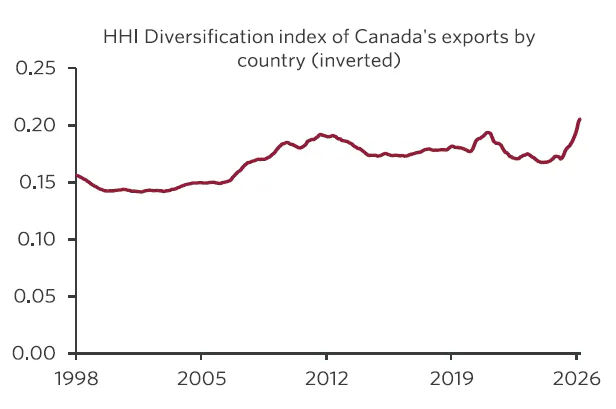
Chart 1: Trade diversification has been slow but accelerated in 2025

Diversifying Canada’s export base is a prudent policy objective in the current global setting, although achieving that at a scale that materially shifts the trade landscape remains a significant challenge. Nonetheless, today’s environment adds urgency to that goal, and any incremental progress in the area delivers tangible benefits — reducing profit volatility, enhancing margins, and encouraging capital investment.
Canada’s primary strategy for addressing trade uncertainties, including the volatility stemming from the US administration’s shifting policies, has been to pursue trade diversification. The aspiration to reduce economic reliance on the United States is not new. Efforts began under Trudeau the father, accelerated during the Harper era, and continued under Trudeau the son. Currently, Canada has 15 active Free Trade Agreements (FTAs) with 51 countries, granting Canadian businesses preferential access to more than 1.5 billion consumers. The countries in those agreements collectively cover over 61% of global GDP and more than one third of the world’s economy outside the US. Notably, Canada stands out as the only G7 nation with FTAs covering all six of its fellow G7 members: the United States, the United Kingdom, Japan, Germany, France, and Italy.
So, considerable groundwork for inducing trade with non-US countries has already been laid. Despite this, however, the tangible impact of trade diversification has been modest. The Herfindahl-Hirschman Index (HHI) of trade diversification by export markets was basically flat until last year when it started to trend upward thanks to diversification efforts in response to Trump’s protectionist trade policies (Chart 1). The share of Canadian exports destined for the US has declined from 76% in 2024 to 69% over the past twelve months, replaced largely by demand from China and European countries, when looking at exports excluding gold (Chart 2). The only sector facing US tariffs that has meaningfully been able to diversify is aluminum, suggesting that the shift away from the US is occurring more broadly amongst Canadian exporters, as the other sectors hit by tariffs either don’t have immediately viable intercontinental markets or are diverting goods to the domestic market.

While that progress is noteworthy, it falls short of transformative change. The reasons are clear: as Professor Paul Krugman put it, Canada is closer to the US than to itself, while the sheer scale of the American market is difficult to resist. While the initial diversification efforts have addressed the low hanging fruit, maintaining this pace will become increasingly challenging. To provide context, we are currently navigating a global trade war. Much like during the Cold War, countries such as Canada will ultimately be compelled to align with one of the major powers. Despite recent developments, it is clear that Canada’s alignment will remain with the United States.
Although Canadian firms have made some headway in diversifying their customer base, product diversification has not advanced at the same pace. The increasing share of energy exports, which have risen from 13% in 2000 to 25% of exports today, also increasing in volume terms, has overshadowed any diversification in terms of other products. However, excluding energy from the product mix shows a positive trend in diversification in the manufacturing and industrial sectors, where the HHI has increased substantially (Chart 3). Notable contributors include ores and concentrates, iron and copper, pharmaceutical products, oil seeds/grains, and more recently, gold.

Expanding into new markets demands additional investment and resources but is associated with improved financial performance. Academic research indicates that the relationship between export diversification and corporate profitability is highly non-linear: both limited and excessive diversification can reduce profitability, with the most significant gains realized as firms transition from low to moderate diversification. That gain is achieved by stabilizing profit margins due to hedging against regional economic downturns, exchange rate volatility, and tariffs, along with greater long-term revenue stability, improved economies of scale, and more competitive pricing strategies across international markets. Given that approximately two-thirds of Canada’s exports are still destined for the US, Canada is well positioned to benefit from further diversification.
Boosting export diversification — by destination and by product — is essential not only for sustaining profitability, but also for reducing economic and profit volatility. The post-Great Recession era, characterized by a new mix of economic growth and recent heightened US policy uncertainty, has led to increased volatility in corporate profits (Chart 4). Greater trade diversification can help offset these risks, especially in Canada.

Research from 2013 showed that trade openness reduces growth volatility, particularly when countries have a diversified export product base that can act as a shield against idiosyncratic growth shocks. The paper’s results show that every one-unit increase in product diversification reduces growth volatility by 28%-points, and suggests that product mix is more impactful for moderating volatility compared to the number of trading partners.
Canada has already seen substantial gains from opening trade up over the last five decades. Research from 2020 shows that Canada’s diversification of trade amongst countries has reduced the volatility of real income by more than average, with volatility 100% lower in Canada’s case than it would have been if trade barriers/diversification had stayed at 1972 levels, which reflects reduced exposure to country-specific shocks. However, Canada’s real income volatility due to specialization has increased by 27% relative to the 1972 conditions, reflecting a high sectoral specialization relative to the other 25 countries in the sample, concentrated in energy products. That suggests that Canada could gain more stability in real income by diversifying its export product base, although the net impact shows that Canada has already outperformed the average in terms of volatility reduction since 1972, driven by diversifying its trading partner base (Chart 5).

The current climate presents a unique opportunity for Canadian businesses to realign their strategies, reducing dependence on the US market while strengthening their financial performance. Achieving this, even at the margin, will require sustained, deliberate efforts to diversify exports by both destination and product, recognizing that diversification is no longer optional, but a necessity.