
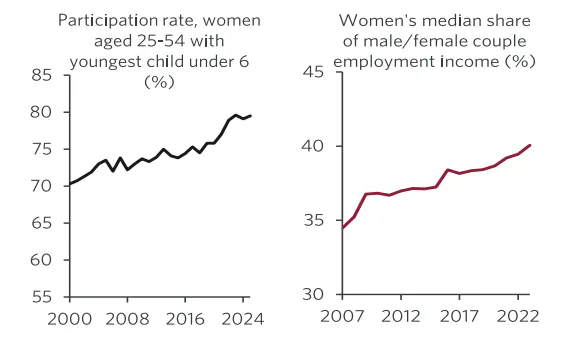
Chart 1: Gains in participation for women with young children (l); women contributing more to family incomes (r)

With women making up a sizeable share of the workforce, making full use of their potential is an issue of great importance for Canada’s economy. As we celebrate this year’s International Women’s Day, it’s noteworthy that we’re seeing some signs of improvement, but there is still plenty of work ahead in addressing a well-known gap, the so-called “motherhood penalty”, that shows up in weaker earnings for women with children relative to their counterparts that do not have children.
The progress seen to date has been tied to the expansion of subsidized daycare which has resulted in a jump in participation for women whose youngest child is under the age of 6 (Chart 1, left). That is helping to limit the number of years spent out of the workforce, which can cost mothers valuable career opportunities and years of experience. In line with that increase in labour market participation, women are accounting for a rising share of family incomes, amounting to 40% for the median contribution of women in male/female couples (Chart 1, right).
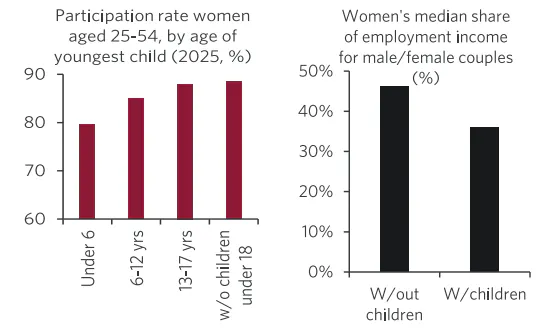
But a closer look shows that the motherhood penalty has yet to be conquered. Women with children under the age of 6 still have a 9-percentage point participation gap to women without children under the age of 18 (Chart 2, left), although that has narrowed from 12-percentage points in 2019. Still, the shortfall translates into women with children accounting for a smaller share of family incomes than those without children (Chart 2, right).
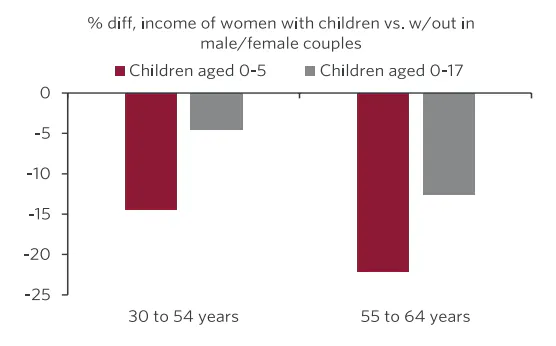
Women experience a large drop in earnings upon maternity leave, and ten years after the birth of the first child, the gap is narrower but still exists. Canada’s latest Census data suggests that the average motherhood penalty is 18% for women with children ages 0-5, with the penalty narrowing to 9% for women with children aged 0-17 (Chart 3). And those are conservative estimates, as numerous studies show that after holding other income determinants constant, even larger gaps in earnings that negatively impact women with children prevail.
Research from Université du Québec à Montréal found that, after controlling for differences in factors like education and occupations, there was a 34% long-run motherhood penalty in Canada, following an immediate 49% drop in earnings during the year of the first child’s birth. Long-run earnings penalties are defined as the average penalty seen from 5-10 years after the birth of the first child. Other research suggests that these range from 21% to over 60% across other advanced economies.
For countries that have generous parental leave policies, like Sweden and Denmark, long-run penalties are reduced, and estimated at 26% and 21%, respectively. That compares to countries with less generous child care and parental leave policies, including in the UK and US, where the gaps are 44% and 31%, respectively. That also suggests that not all of the penalty is due to the decision of whether or not to return to work, but also how many hours to work upon return and at what wage rate.
Spending time with children is an important part of parenthood, but these duties, and their impact on career earnings, are far from shared equally among male/female couples. As a result, pre-children, the earnings paths of women evolve generally in line with men, and men’s earnings are generally unaffected by births, and may increase in some cases due to a propensity to work more hours after having children. Those decisions by their spouses could be one reason why mothers feel compelled to select jobs that require less demanding hours.
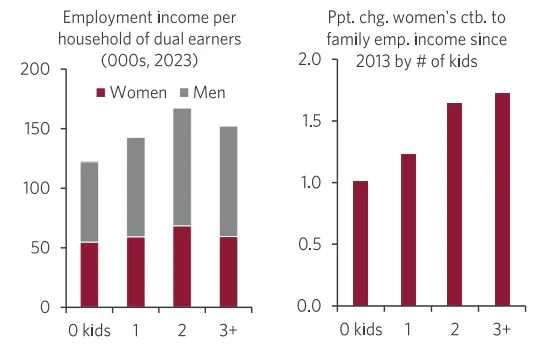
Looking at income tax filings from 2023 sheds some further light on the motherhood penalty in Canada. Women in male/female dual-earner couples with children contribute about 40% of family employment income, versus almost 45% for those in couples without children (Chart 4, left). However, the contribution from women with children has increased notably over the prior decade, specifically for those with two or more children (Chart 4, right). The UQAM research shows an increasing motherhood penalty in Canada as the number of children rises, with the long-run penalty of mothers with one child almost non-existent by the time the child turn 10, as opposed to 37% and 47% penalties for women with two and three or more children, respectively. That said, the rising share of women’s incomes within families suggests that these gaps could be changing.
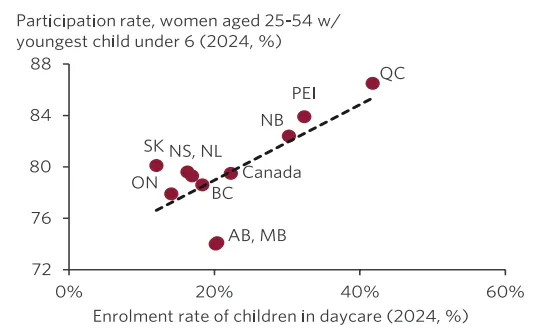
Quebec began expanding access to subsidized daycare in the late 90s. And the results from the UQAM paper show that the long-run earnings penalty for Quebec mothers were greatly reduced after those policies were implemented. Prior to the expansion of subsidized daycare, long-run earnings penalties amounted to 40%, but dropped sharply after the implementation of those policies to 23%. Looking at daycare enrolment rates, there is still plenty of ground for other provinces to make up in order to catch up to Quebec’s progress, which should put downwards pressure on the motherhood penalty in other provinces in the decades ahead (Chart 5).
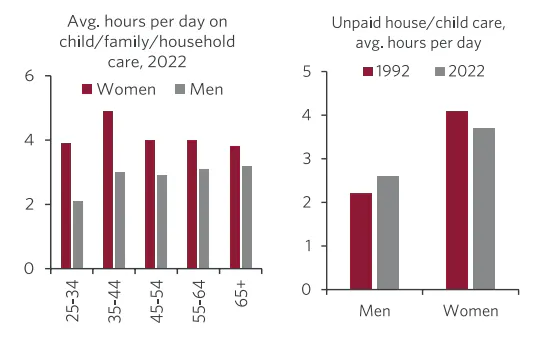
One other reason why women with children haven’t been able to close gaps in the labour market is likely tied to societal norms around the burden of unpaid childcare and household work. As noted above, men with children often increase their hours worked, leaving more parenting tasks for their spouses. For the 25-44 age group, women average roughly two more hours per day on those tasks relative to men (Chart 6, left). Looking back to thirty years ago (Chart 6, right), the aggregate gap across age groups has almost been cut in half, but women are still doing more of those unpaid tasks than men, eating into time that could be spent doing paid work and paring back opportunities for career development.
As noted in prior sections, the motherhood penalty is not just a product of the decision to return to work for mothers, but also the hours to work and at what wage rate. Prominent research has shown that mothers seem willing to trade lower pay for more amenities at work, including working at firms with fewer hours and working at firms that are more accommodating around employment interruptions, jobs that in turn offer lower pay.
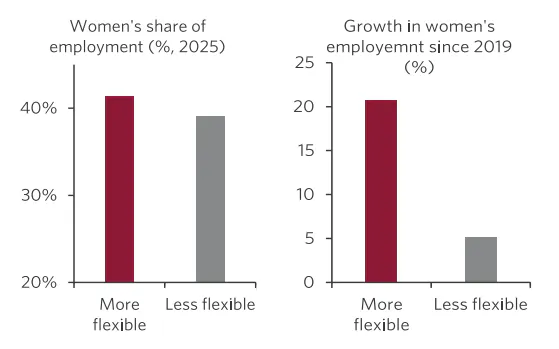
Although we don’t have data on employment in flexible industries broken down into women with and without children, we can see that women have a slightly larger share of employment in more flexible industries, defined as those where at least 35% of employees have adaptable hours (Chart 7, left). And growth in employment for women has overwhelmingly been concentrated in more flexible industries since 2019 (Chart 7, right).
The evidence is clear — higher labour force participation for mothers as children get older reduces the motherhood penalty. However, it persists due to a few reasons — the benefits of subsidized daycare have not yet been fully realized as shown in enrolment rates, which translates into a hit to years of work experience down the road, while the societal burden of unpaid tasks is still tilted more towards women, which may leave women in lower paying jobs that offer more flexible work arrangements.
Raising children takes time, and that investment has its rewards. But allocating that time more equally within male/female couples, and making childcare more cost effective, can help reduce the degree to which parenthood cuts into economic activity and women’s career progress.
